

Flyers and brochures
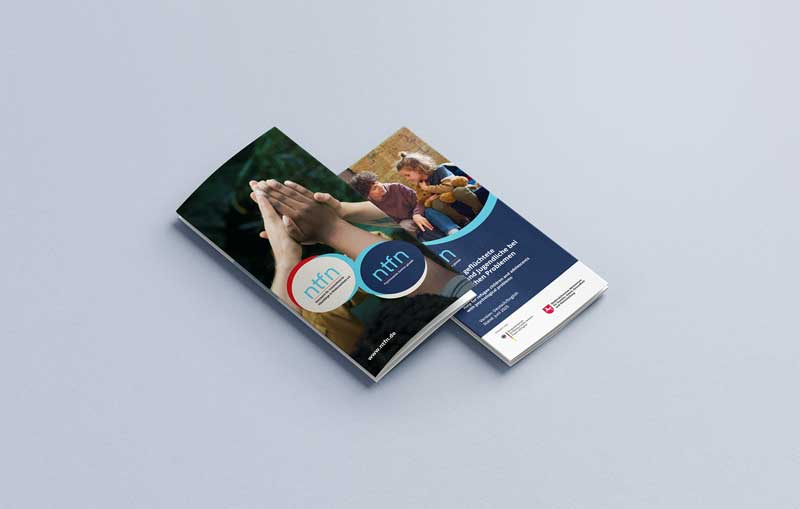
Do you need printed flyers for your organization? Send us an informal email to info@ntfn.de and we will send you copies.
In the download area you will also find the current NTFN flyers in digital form:
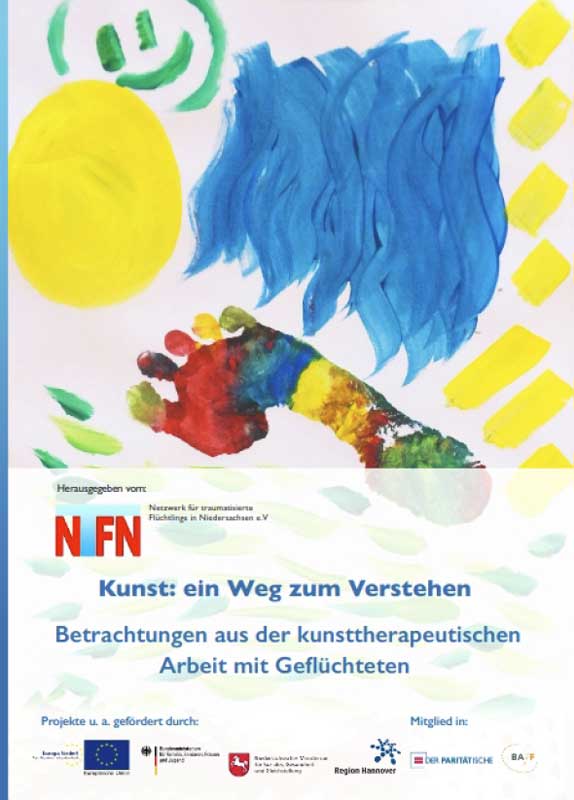
Brochure “Art: A Path to Understanding”
Art therapy is used in our psychosocial centers as a language-reduced, creative form of treatment. In art therapy, refugees can express themselves through their artwork and address topics that might be more difficult to express in conversation.
An insight into this work is offered by the brochure “Art: A Path to Understanding. Reflections from Art Therapy Work with Refugees,” published in December 2021. The contributions also include numerous images created during art therapy sessions. Thus, the brochure provides insight into art therapy practices as well as the experiences and living conditions of refugees.
We accept orders at info@ntfn.de . In return, we would appreciate a donation.
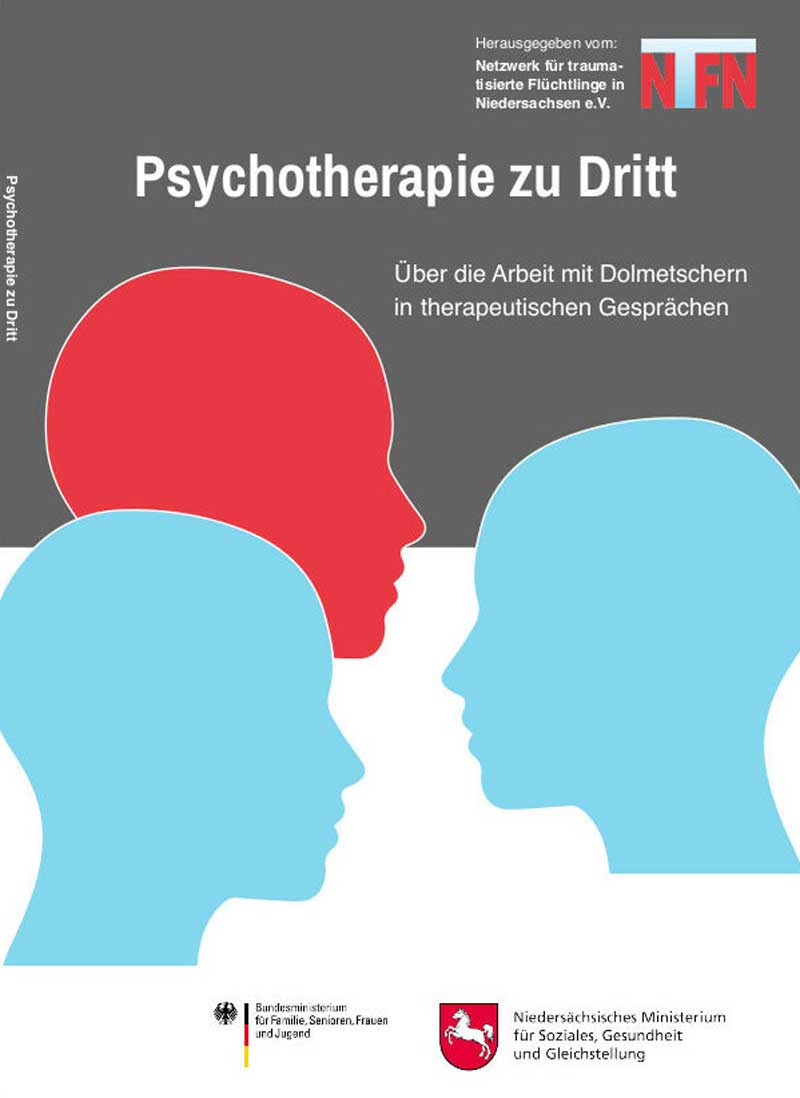
Brochure: “Psychotherapy in Threes: On Working with Interpreters in Therapeutic Conversations”
How can I meaningfully integrate interpreters into treatment discussions? And what framework is needed to make the situation constructive for all involved?
These and other questions are answered in the reader “Psychotherapy in Threes.” It has been published by the Network for Traumatized Refugees in Lower Saxony (Netzwerk für traumatisierte Flüchtlinge in Niedersachsen e.V.) since 2008. The contributions are practice-oriented and incorporate various perspectives – those of psychotherapists, interpreters, and clients. Therefore, it is equally informative for all professionals involved.
In addition to articles and interviews, the appendix contains various materials, including sample applications for outpatient psychotherapy according to Sections 4 and 6 of the Asylum Seekers' Benefits Act (AsylbLG). It also includes contributions on financing interpreter costs (Nina Hager, legal expert at BAfF eV) and on preventing secondary traumatization of interpreters (Kristina Grundmann, educational scientist).
We accept orders at info@ntfn.de . In return, we would appreciate a donation.
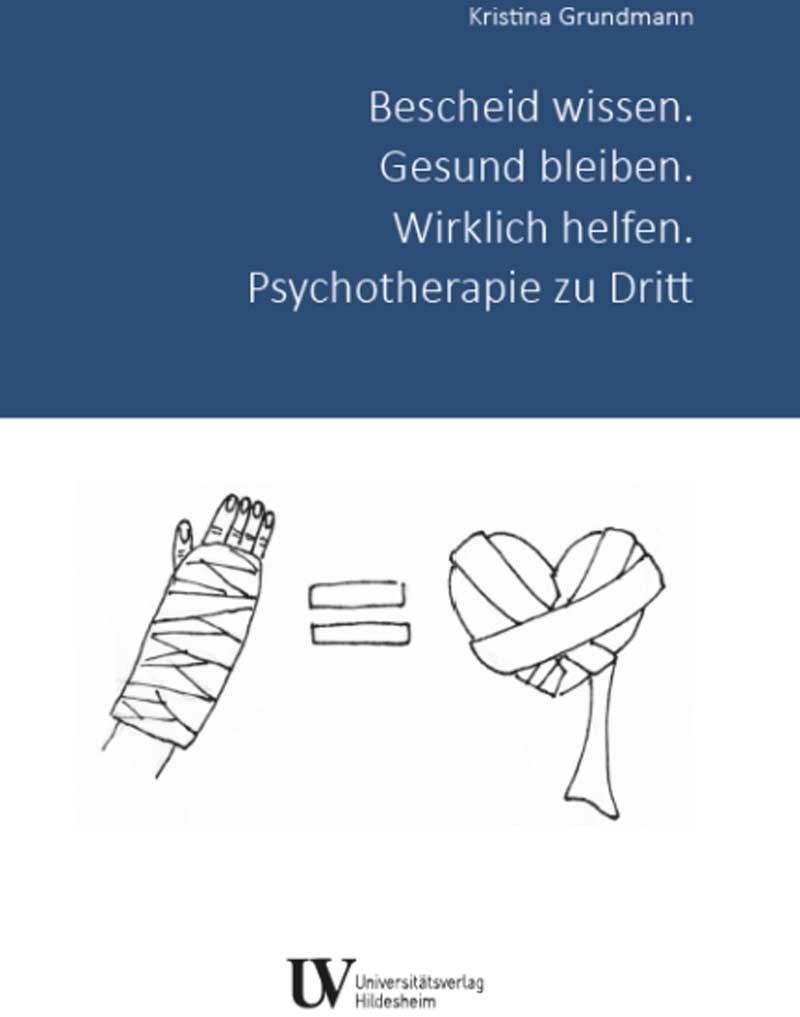
Brochure on secondary traumatization among interpreters: "Know the facts. Stay healthy. Really help. Psychotherapy in a three-way relationship"
In collaboration with NTFN eV, educationalist Kristina Grundmann has created the brochure “Know Yourself. Stay Healthy. Really Help. Psychotherapy in Threes.” In addition to providing fundamental information on the topic of trauma and psychotherapy, the brochure also addresses the dangers of secondary traumatization for interpreters and how to prevent it. The brochure is intended as a practical guide for interpreters and is also suitable for those with little prior experience in this field.
The brochure was published by Hildesheim University Press. An English translation is also available. Please send your order to info@ntfn.de . We would appreciate a donation in return.
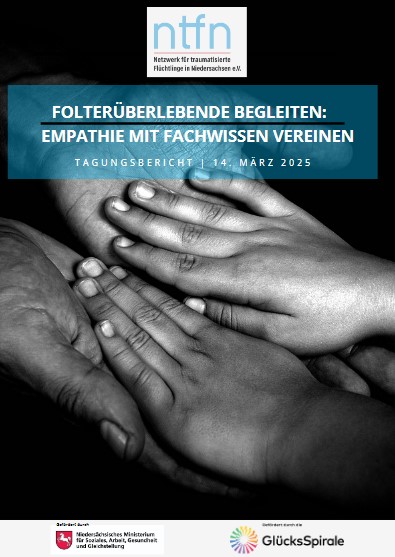
Conference report: “Accompanying torture survivors: Combining empathy with expertise”
Refugees repeatedly report horrific crimes committed against them in their home countries or during their flight. In March 2025, the NTFN eV (National Network for Refugees) dedicated a conference to this topic, exploring the following questions: What complex effects do extreme experiences of violence have on the body and mind? What practical approaches exist for coping with them? What is the purpose of documenting signs of torture, both legally and emotionally? And what needs and perspectives do people who have survived the most severe forms of violence have?
The conference report is recommended not only for the participants at the time, but generally for all people who work in the social, psychosocial, psychotherapeutic or psychiatric field with refugees (and thus potential torture survivors).
We accept orders at info@ntfn.de . In return, we would appreciate a donation.

Newsletter & event mailing list
Would you like to stay informed about current projects and news from NTFN eV? Our NTFN newsletter (4-5 times a year) will keep you up to date.
Would you like to receive information about our events, training courses, and continuing education programs? We would be happy to add you to our mailing list . Simply send an informal email to fortbildungen@ntfn.de.

Business reports
We report on the work of NTFN Psychosocial Centers gGmbH in our annual business reports.
The annual reports from previous years can be found in the download area.

Therapy with interpreters
Training videos for therapy with interpreters
In 2023, NTFN gGmbH, in cooperation with Yarmouk University in Amman, conducted a project to train interpreters in Germany and Jordan. As part of the project, eight instructional videos were produced on working with interpreters in therapy and counseling settings (funded by the Lower Saxony State Chancellery).
These videos are aimed at therapists, counselors, and interpreters alike, and present typical and challenging counseling situations. These include, among others, initial consultations with clients, pre- and post-session discussions with interpreters, sudden interruptions of sessions, nervous and agitated clients, and the difficulty of accurately interpreting all content in such situations.
The videos aim to foster a better understanding of the different roles in a counseling session. They also provide concrete recommendations for collaboration in therapy and counseling involving three people. Checklists at the end of each video offer practical suggestions.
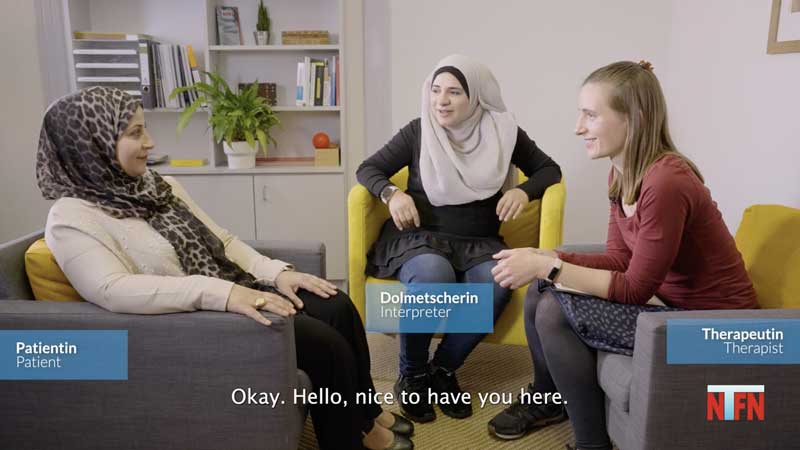
All eight videos can be ordered by email at e.lutter@ntfn.de for a fee of €49. You will receive a link via email from which you can download the approximately 20-minute video files within seven days.
Target audience: Interpreters, therapists, counselors. Content: 8 videos of approx. 2 minutes each (total duration: 20 minutes). Language: German (with English and Arabic subtitles).
You can watch one of the videos for free here:
[Video 2]: Initial consultation with a new patient
We are pleased to offer you training courses in psychotherapy with interpreters. Addresses and links to interpreting services can be found in our information database.

Mental illness in asylum proceedings
Refugees who have suffered severe forms of psychological, physical, or sexual violence, as well as refugees with mental health disorders, are considered particularly vulnerable under EU Reception Directive 2013/33/EU . This means that, given their specific needs, they are entitled to special procedural safeguards. This primarily concerns the asylum process itself (e.g., the involvement of specially trained decision-makers).
Further information on the EU Reception Directive can be found in our guide on dealing with traumatized and mentally ill refugees in the reception procedure in the download area.
Mental illness and residency rights
Basically, there are two different types of possible obstacles to deportation due to health reasons.
1. Country-specific obstacles to deportation
Section 60, 7 of the Residence Act
1 "Deportation of a foreigner to another state should be waived if there is a significant concrete danger to the life, limb or liberty of that foreigner in that state." § 2 60a Paragraph 2c, sentences 2 and 3 This applies accordingly. 3 A significant, concrete danger for health reasons exists only in the case of life-threatening or serious illnesses that would be substantially worsened by deportation. 4 It is not necessary that medical care in the destination country be equivalent to care in the Federal Republic of Germany. 5 Adequate medical care is generally also present if it is only guaranteed in part of the destination country. 6 Dangers according to sentence 1, to which the population or the population group to which the foreigner belongs is generally exposed, are not to be taken into account in orders issued pursuant to § 60a Paragraph 1, sentence 1 to consider.
Currently, when examining country-specific obstacles to deportation based on health reasons related to mental illness, the Federal Office and courts are only required to consider "qualified specialist medical certificates." This exclusion of certificates issued by psychotherapists makes it more difficult for refugees to raise mental illnesses and their need for treatment within the asylum process. The German Federal Chamber of Psychotherapists (BptK), our umbrella organization BAfF, and several medical associations have repeatedly criticized this regulation as professionally unfounded.
2. Domestic obstacles to deportation
The restriction to specialist medical certificates also applies to the determination of so-called "unfitness to travel" as a domestic obstacle to deportation by the immigration authorities.
60a Residence Act
(2c) 1 It is presumed that there are no health-related reasons preventing deportation. 2. The foreigner must provide credible evidence of an illness that could impede deportation by means of a qualified medical certificate. 3. This medical certificate should include, in particular, the factual circumstances on which the professional assessment was based, the method of fact-finding, the professional medical assessment of the illness (diagnosis), the severity of the illness, the Latin name or classification of the illness according to ICD-10, and the consequences that, according to the medical assessment, are likely to result from the illness. 4. Medications required for the treatment of the illness must be listed, including their active ingredients and their internationally recognized names.
(2d) 1 The foreigner is obliged to submit the medical certificate referred to in paragraph 2c to the competent authority without delay. 2 If the foreigner fails to submit such a medical certificate without delay, the competent authority may not take into account the foreigner's statements regarding their illness, unless the foreigner was prevented from obtaining such a certificate through no fault of their own or there are other factual indications of a life-threatening or serious illness that would be substantially worsened by deportation. 3 If the foreigner submits a certificate and the authority subsequently orders a medical examination, the authority is entitled to disregard the stated illness if the foreigner fails to comply with the order without sufficient reason. 4 The foreigner must be informed of the obligations and the legal consequences of a breach of these obligations under this paragraph.
How can NTFN help?
If statements or expert opinions are required for our clients and patients, it is essential that we have all the necessary immigration documents. We have compiled a fact sheet outlining which documents are required.
Doctors who prepare expert opinions or reports generally require a commission with specific questions. Ideally, they succeed in persuading the authorities and courts themselves to commission expert opinions. However, this still happens far too rarely. The following questions may be relevant for expert opinions/reports:
We have compiled further information and helpful links in our information database.
Coverage of therapy and interpreting costs
The procedure for applying for therapy and interpreter costs depends on the applicable legal regulations. There are several options:
- Basic benefits under the Asylum Seekers' Benefits Act (usually during the first 36 months of the asylum procedure)
- Analogous benefits under the Asylum Seekers' Benefits Act (usually after 36 months of residence)
- Health insurance membership (through employment or with a residence permit and benefits from the job center / employment agency)
1. Basic services
For the first 36 months, asylum seekers receive so-called " basic benefits" according to Sections 3 and 3a of the Asylum Seekers' Benefits Act (AsylbLG). Specific rules apply to these benefits; they are lower than regular social assistance payments and can be provided partially or even entirely in kind. After a stay of more than 36 months, asylum seekers are usually provided with so-called "analogous benefits" according to Section 2 of the AsylbLG. These largely correspond in form and amount to regular social assistance under Book XII of the German Social Code (SGB XII).
Those receiving benefits under the Asylum Seekers' Benefits Act (AsylbLG) are not members of the statutory health insurance system. Instead, the social welfare office typically issues medical certificates for cost coverage within the first 36 months, which sometimes need to be applied for for each individual treatment. This process varies from municipality to municipality.
For health services (which also includes psychotherapy), two different paragraphs in the Asylum Seekers' Benefits Act are crucial:
§ 4 AsylbLG “Benefits in case of illness, pregnancy and childbirth”
(1) For the treatment of acute illnesses and pain, the necessary medical and dental treatment, including the provision of medicines and dressings, as well as other services necessary for recovery, improvement, or alleviation of illnesses or their consequences, shall be provided. For the prevention and early detection of diseases, vaccinations in accordance with Sections 47 and 52, paragraph 1, sentence 1 of Book Twelve of the German Social Code and medically necessary preventive examinations shall be provided. Provision of dentures shall only be made if, in an individual case, this is medically urgent.
(2) Pregnant women and women who have recently given birth shall be provided with medical and nursing care, midwifery care, medicines, dressings and remedies.
(3) The competent authority shall ensure the provision of the services referred to in paragraphs 1 and 2. It shall also ensure that those entitled to benefits are offered timely completion of their vaccinations. (…)
and
§ 6 Other Services
(1) Other benefits may be granted, in particular, if they are essential in individual cases to secure subsistence or health, are necessary to meet the special needs of children, or are required to fulfill an administrative obligation to cooperate. The benefits shall be provided as benefits in kind, or, in special circumstances, as cash benefits.
(2) Persons who hold a residence permit pursuant to Section 24(1) of the Residence Act and who have special needs, such as unaccompanied minors or persons who have suffered torture, rape or other serious forms of psychological, physical or sexual violence, shall be provided with the necessary medical or other assistance.
As a general rule: If psychotherapy is approved according to §4 / §6 AsylbLG, the interpreter costs will also be covered if the need is proven.
Note: Some social welfare offices/health departments refuse to cover the costs of psychotherapy for tolerated refugees, citing the lack of effectiveness of trauma-focused psychotherapy when residency status is uncertain. Another reason given for refusal is that post-traumatic stress disorder can only be successfully treated once residency status is secure. The Psychotherapists' Chamber of Lower Saxony, however, presents a contrary view in a statement.
2. Analog services
After a 36-month stay, the social welfare office must automatically provide benefits under Section 2 of the Asylum Seekers' Benefits Act (AsylbLG), the so-called "analogous benefits." This means that while those affected remain entitled to benefits under the AsylbLG, almost all regulations of "normal" social assistance (according to Book XII of the German Social Code) are applied to them. This also means that they receive a health insurance card without restrictions on their entitlement to treatment and that additional needs allowances are explicitly applied.
Access to psychotherapy then follows the usual regulations of the health insurance company.
Aside from the general shortage of psychotherapy places in Germany, access for refugees remains particularly difficult as long as language interpretation is necessary: interpreter costs are not covered by health insurance. They must therefore be applied for separately, usually at the responsible social welfare office.
3. Health insurance membership
Employment or receiving benefits from the job center or employment agency automatically results in full membership in a health insurance fund. This has little impact on eligibility for benefits. However, the costs are now covered by the health insurance fund and no longer by the social welfare office. Even when receiving benefits from the job center, interpreter costs can be claimed as additional needs allowances under the German Social Code, Book II (SGB II).
Applying for therapy and, if necessary, interpreter costs is often very tedious. NTFN eV can support you in this process. For this, we usually need some information, which you can find HERE.
We have compiled further information, application assistance and sample cost approvals in accordance with Section 53 SGB XII and Section 73 SGB XII in our information database.

Information database
The NTFN information database compiles information that can be helpful for traumatized refugees and their supporters. Regarding support structures, it focuses on the state of Lower Saxony. The database is continuously updated; we welcome additions to our entries at praktikantin_pr@ntfn.de.
Psychosocial Center Braunschweig (NTFN eV)
Postal Code: 38108
Location: Braunschweig
Office hours and contact information: info-bs@ntfn.de
Psychosocial Center Göttingen (NTFN eV)
Postal Code: 37073
Location: Göttingen
Office hours and contact information: info-goe@ntfn.de
Catchment areas: The city and district of Göttingen, as well as the districts of Northeim, Holzminden, and Goslar.
Psychosocial Center Hanover (NTFN eV)
Postal Code: 30171
Location: Hanover
Office hours and contact information: info@ntfn.de
Catchment areas: City and region of Hanover, surrounding districts, and mediation throughout Lower Saxony
Psychosocial Center Lüneburg (NTFN eV)
Postal Code: 21335
Location: Lüneburg
Office hours and contact information: info-lg@ntfn.de
Catchment areas: Lüneburg and surrounding regions
Psychosocial Center Oldenburg (NTFN eV and IBIS eV)
Postal Code: 26122
Location: Oldenburg
Office hours and contact information: info-ol@ntfn.de
Catchment areas: Oldenburg and surrounding regions
Branch office of NTFN eV in Cuxhaven
(together with the MVZ Timmermann and Partners)
Postal Code: 27472
Location: Cuxhaven
Office hours and contact information: Contact: info-cux@ntfn.de
Catchment areas: Cuxhaven and surrounding regions
Psychosocial Center Osnabrück (NTFN eV)
Postal Code: 49074
Location: Osnabrück
Office hours and contact information: info-os@ntfn.de
Catchment areas: City and region of Osnabrück as well as the districts of Vechta, Cloppenburg, Emsland, Grafschaft Bentheim
Social psychiatric services in Lower Saxony
In an emergency, you can also find help at the social psychiatric service responsible for your region. The Lower Saxony State Office for Psychiatric Coordination provides an overview of the addresses of social psychiatric services in your region.
Psychosocial Center of the Diaconal Association Göttingen
Postal Code: 37073
Location: Göttingen
Catchment areas: City of Göttingen
Focus on cultures, migration and mental illness / Asklepios Specialist Clinic Göttingen
Postal Code: 37081
Location: Göttingen
Office hours and contact information: For contact information, see link.
What it is: Outpatient services
Special consultation for patients with a refugee and migration background, KRH Psychiatry Wunstorf
Postal Code: 31515
Location: Wunstorf
Special consultation for patients with a refugee and migration background, KRH Psychiatry Wunstorf, Nienburg location
Postal Code: 31582
Location: Nienburg/Weser